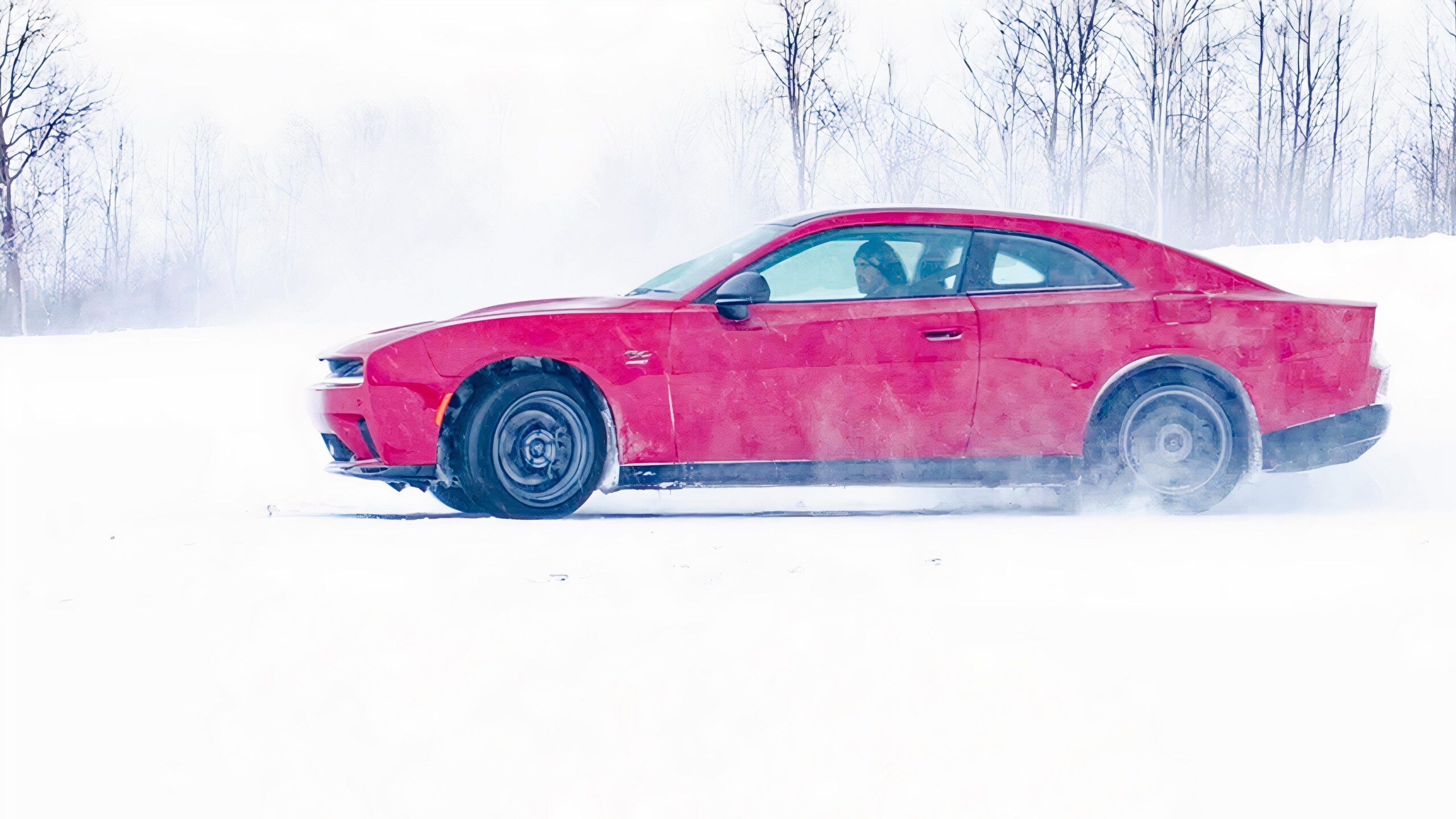
What’s a little friction between siblings? You might rightly ask that, since Dodge released a video yesterday of the all-new,
Dodge Charger Daytona EV
ripping around a snowy testing facility, apparently to prove that you don’t need a Jeep to conquer winter. Unless, perhaps, Jeep has its own electric rig in the wild. Dodge teased the footage showing a Dodge Charger Daytona Scat Pack and Charger Daytona R/T on ice and snow in Michigan’s Upper Peninsula.

2025 Dodge Charger Daytona
- Model
-
Charger Daytona EV
- Engine
-
Dual Electric Motors
- Horsepower
-
670 HP
- Torque
-
627 LB-FT
- Driveline
-
AWD
- 0-60 MPH
-
3.3 Seconds
- Top Speed
-
137 MPH
8:34

Related
2024 Dodge Charger Daytona Scat Pack EV First Drive: Proof That Electric Muscle Cars Can Be A Thing
The Charger Daytona EV proves thoroughbred American muscle cars can still exist for the 21st century, no matter where the power comes from.
Who Needs an SUV?
Because both the 670-horsepower Daytona Scat Pack and 496-horsepower Daytona R/T have all-wheel-drive capability, with dual motors, and relatively even front/rear weight distribution, it’s not very surprising they perform decently with next-to-zero grip. Dodge wanted to tout some winter-specific features, however. The Charger Daytona’s rear motor has a mechanical limited-slip differential, much like you’d see from a Charger from the way-back machine of the 1960s.
If you want to get the most traction, you’d switch your Charger Daytona to Wet/Snow drive mode, which splits the torque evenly between the front and rear axles.Naturally, that’s what you’d do if your goal was to poke carefully down a public, ice-caked byway. Dodge wanted to show off Drift/Donut Mode, which disconnects the front axle and powers only the rear. If there was pavement involved, you’d see a lot of burnt rubber and clouds of smoke. Here, Dodge got to use 627 pound-feet of torque to spray innocuous frozen water.
Boring, But Important
Dodge isn’t showing videos of people who live in Michigan’s far north using the limited-slip differential to get unstuck from their snowy driveways. That’s not interesting footage. But should that be you, they do tout that their EV’s system features that LSD, and the way it works is by sensing slip at one of the two rear wheels, and then sending power across to the non-spinning wheel. That’s exactly how LSDs work if your Charger runs on gasoline and it’s so equipped. The difference is that with so much electric torque hitting when you tap the throttle in an electric
Charger Daytona,
wheel slip is going to be way harder to control.
That’s why Dodge also integrates Wet/Snow Mode, which uses traction control, stability control, and brake re-gen to slow power throughput to any one of the four driven wheels that are spinning, essentially “studying” the output in search of traction, while also looking at the attitude of the car in relation to where the driver’s steering, to try to course-correct for spinning out.
The Fun Stuff

Dodge wouldn’t be Dodge if they didn’t hype Drift/Donut Mode, which, they emphasize, spikes stability control entirely and simply lets the system hunt for available traction. They also stress that this kind of amusement will continue to be available to buyers who want to buy a gas car instead, and that those buyers should keep their eyes peeled for the Dodge Charger SIXPACK, which arrives sometime this summer and likewise, will feature all-wheel drive.
What it won’t feature is more ground clearance, so when you see Dodge testing the Charger Daytona EV driving through what appears to be about four inches of slush, that’s basically the wading depth. When it comes to all-wheel drive, electrification, and off-roading, our money’s still with Jeep, thanks very much.