Ford is about to reinvent itself—once more. As we speak the carmaker introduced the manufacturing of a brand new, $30,000 mid-sized electrical pickup with the efficiency of the Mustang EcoBoost, however in a novel package deal that features the crossover versatility of a Toyota’s RAV4.
There is a cause Ford talked about the RAV4 in right this moment’s announcement. It occurs to be the best-selling car in America, and it can’t be misplaced on Ford that its personal luster, relying so closely on the F-150, is fading. Ford’s CEO, Jim Farley, mentioned in the course of the carmaker’s July earnings name that the corporate needed to shift away from pondering that $60,000-$70,000 EVs had been going to work, in a transparent reference to the failed technique behind the Lightning.
However Toyota, a dominant participant in hybrids, i.e., the RAV4, but in addition the Tacoma and Highlander, Ford’s pivot on EVs is each a bid to leapfrog Toyota—and in addition get out of its personal manner on pricey EV manufacturing.
A $30,000 Pickup

By 2027 Ford plans to promote a midsize four-door electrical pickup. Ford says they’re “focusing on” a $30,000 value and that the truck can be made at their Louisville meeting plant (the place they presently make the F-150).
Particulars embody:
- As quick as a Mustang EcoBoost, which, for reference, means a 0-60 MPH time of 4.5 seconds. For a truck, that is very fast certainly.
- As roomy because the Toyota RAV4. Which means it’s going to be a real mid-size, and would section above the present Ford Maverick.
- Intelligent storage, together with an in-bed trunk that’ll match (based on Ford) surfboards beneath the mattress ground.
A Do-Over on Batteries

Ford clearly heard the messaging from would-be patrons that they are apprehensive that they are environmentally in some way worse than the CO2 that comes from gasoline vehicles (factually unfaithful, however a persistent narrative). So for his or her new LFP batteries, they’re broadcasting that they will be made domestically, solely freed from nickel and cobalt. Additional. They’ve made clear that E-REVs are a part of their future, that means hybridization of a unique type, significantly for bigger, heavier-duty use.
However their huge advance will come from a brand new battery design of their very own making, utilizing more cost effective LFP chemistry. Crucially, the brand new battery kinds the spine of the car construction.
It All Begins With a Modular Chassis—With Approach Fewer Components

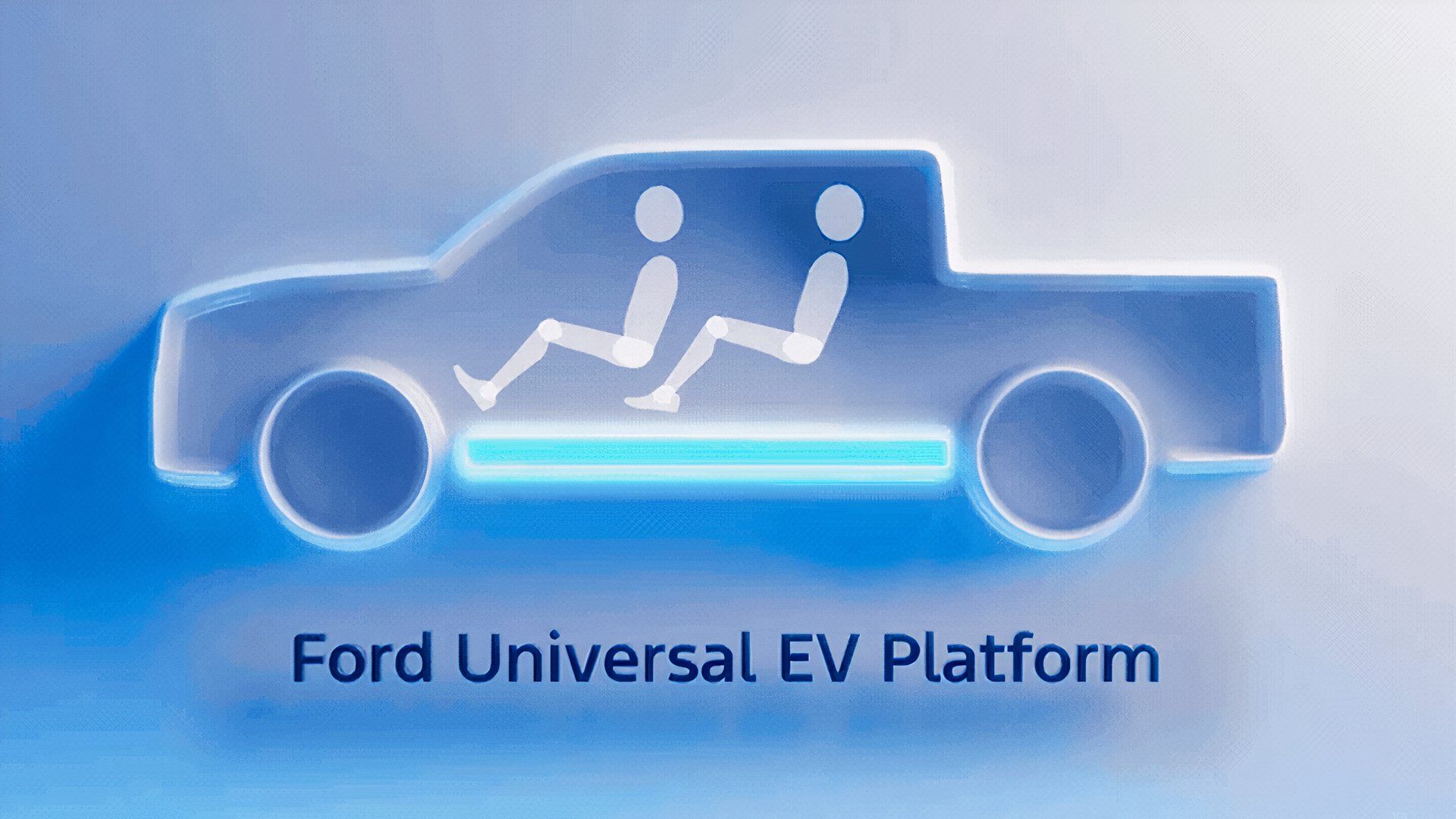
We have all heard that EVs are manner much less advanced than gasoline vehicles. However carmakers have not essentially been altering the best way the vehicles are assembled. Ford says that is what it is doing with their new, systemic method. The thought is to make one core, central passenger cell, that features the construction of the battery as a structural piece. As that module strikes down the road the carmaker will add, say, a 3rd row, or a pickup truck mattress.

Ford says this method permits making many vehicles on the identical line, since each unit will get the identical sub-structure.
Like Slate, the objective for Ford is to cut back the components depend—Ford says by 20 p.c.
Citing one instance, Ford, in an oddly-phrased assertion, mentioned the wiring harness within the new midsize truck “can be greater than 4,000 ft shorter and 10 kilograms lighter than the one utilized in our first-gen electrical SUV.” That is in reference to the Mach-E, the place Ford has beforehand cited an under-investment within the improvement of that automotive’s costly and massively over-cost wiring.
Software program-Designed—Like Rivian and Tesla

The brand new EV methods method guarantees to be “software-defined,” the newest buzzword in carmaking that is alongside the strains of Rivian’s centralized software program stack. Volkswagen invested in Rivian exactly as a result of their legacy manner of constructing vehicles—shopping for electronics from a number of distributors after which making an attempt to knit all that collectively—is much too pricey and complicated.
Ford’s method will mirror Rivian and Tesla. All the software program stack can be a single OS, which enormously reduces complexity and permits true over-the-air updates. In principle, this must also make non-mechanical over-the-air updates a seamless affair. And, very similar to Tesla, they will cost you extra if you need extra superior BlueCruise beamed to your automotive.
TopSpeed’s Take

Ford has made some odd claims on this announcement. They mentioned the ensuing simplification of their new line of EV’s will result in a “…Decrease value of possession over 5 years than a three-year-old used Tesla Mannequin Y.” That is a canine’s breakfast. What does it imply? Does it imply that the brand new car will not be as dependable within the first three years of possession as that Tesla Mannequin Y?
We do not know. We do know that Ford has made some lofty targets. They talked about that their custom is to make automobiles round passionate prospects, and that a lot is true. Ford has some very devoted prospects round fashions just like the Bronco, the F-150, and now the Maverick. Clearly, that is true of Mustang.
However a really clear drawback has stood in the best way of Ford gaining an identical following with EVs—value.
Ford needs to be eying Chevy’s Equinox EV, which is quickly stealing Tesla Mannequin 3 gross sales, with some envy.
To leapfrog GM, catch Tesla, and compete with know-how from China, which is actually main the software-defined car and chassis improvement, can be an enormous problem. And by the best way, Slate Auto can be stating the failings in how all carmakers method design and execution. The upshot: Ford’s “Mannequin T Second” goes to demand wholesale adjustments, not simply in a single manufacturing unit or one battery plant, however throughout your entire firm.