I came up with the idea for this op-ed as I was plowing through Montreal’s second back-to-back winter blizzard behind the wheel of a 2025 Chevrolet Equinox EV. Front-wheel-driven (in my case), and providing way more range than I actually needed, the Equinox EV’s brilliance has so far seduced more than 30,000 buyers in the U.S. and Canada. With a starting MSRP of $41,900, it’s a darling of an electric vehicle (EV), taking off where the adorable Bolt EV left off, and giving established EV brands Tesla and Hyundai a run for their money by selling common folk a spacious, well-put-together little SUV with competitive range.
The Equinox EV is just one of the many new products GM is winning with these days. In all spheres of the industry, from EVs to pickup trucks and even sports cars, the General is killing it right now. And it’s all spearheaded by engineering and business superstar Mary Barra’s “I don’t want to relive 2009” ethos.

Related
A 60-Percent Charge In A Silverado EV Equates To A Normal EV’s Full Range, Even In Winter
But, it doesn’t predict range all that well in the cold.
A Hummer EV With That?
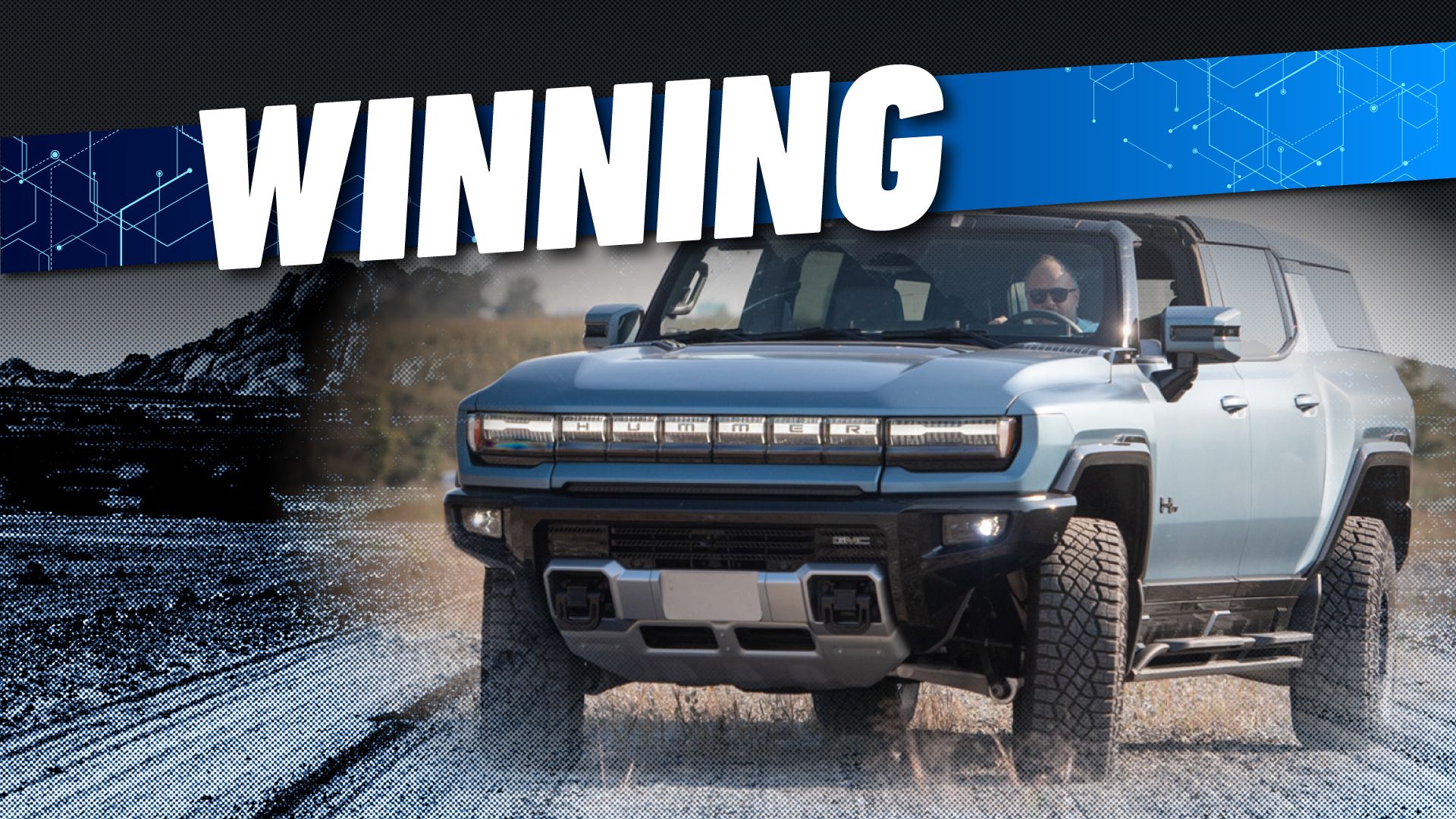
When I was given the privilege of bringing a Hummer EV SUV back home to review last summer, I remember, after connecting it to my level 2 home charger, that I couldn’t believe the darn thing even existed. My then one-year-old son would stare at the gargantuan machine from our living room window, presumably in awe that one of his toy tonka trunks had magically transcended into the real world. The Hummer EV is larger than life, cooler than cool and the sort of future-is-now revolutionary product we auto/tech geeks love writing about.
But also, by any measure, the Hummer EV is a useless thing. Sure, I guess we’re all glad that a Hummer no longer consumes fuel to move around, but do we actually care? Did we really need another Hummer? I’m sure there’s something better we can do with the resources required to build its 170-kWh lithium-ion battery. Right?

The Hummer EV would be a joke if it came from a carmaker that sells no other EVs. But this is GM we’re talking about, an automaker that’s been heavily invested in EVs since the first-generation Chevy Volt. While the Ultium Cell technology took time to arrive due to post-COVID manufacturing challenges, when it finally hit the market with a full lineup of attractive and competitive EVs, it landed like a ton of bricks. If GM is selling a vehicle as ostentatious as the Hummer EV, it’s not because it’s trying to prove a point. It’s because it can. If you’re not happy with it, GM will be more than happy to sell you an
Equinox EV
, a Blazer, or even a
LYRIQ
. The Hummer is just General Motors flexing, and grinning.

Related
And it’s not as if the company is backing down on its EV strategy. While most automakers have recently made big announcements about how they’ll change their EV roadmap by rolling out more hybrids, GM is multiplying its electric vehicle portfolio faster than pioneering EV brands like Tesla, Lucid, or Rivian. As I write this, GM currently offers eight fully electric models. Two more are expected to arrive this year at Cadillac, to say nothing of its Chevrolet Brightdrop line of electric cargo vans. Oh, and don’t think GM is doing this at a loss, because its EVs are profitable.
It’s Over 1,000!
Electric vehicles aside, GM is also the carmaker that released the 1,064-horsepower, mid-engine Corvette ZR1. Remember that one? As if the regular C8 Corvette, the E-Ray, and the high-revving, track-record-setting Z06 weren’t enough, the ZR1 tops the Corvette lineup as the most powerful model in the history of the nameplate. It has already set a top speed record of 233 MPH and its optional aero package will generate more than 1,000 pounds of downforce. Oh, and GM isn’t done improving its giant-slaying Corvette. An even more powerful Zora model is apparently underway.
The Corvette and EVs are all but two chapters in GM’s success story. While it continues to invest steadily in electric propulsion, it hasn’t left its internal combustion engine (ICE) models behind. I recently took a Chevrolet Colorado ZR2 along a muddy trail and the darn thing conquered it with as much ease as it takes me to gobble up a six-inch sub.

Related
2025 Chevrolet Corvette ZR1 Packs 1,064 HP, Generates Over 1,000 Pounds Of Downforce
The Corvette ZR1 boasts insane numbers, allowing it to become the fastest, most powerful Corvette ever.
Earlier this year, I had a stab at the recently updated GMC Acadia. Sure, yet another three-row SUV, but one that manages to hold its own through a generally well-put-together product and a surprisingly capable AT4 version. The entry-level Buick Envista also proved to be a refreshing, sort of out-of-left-field approach to the suffering premium coupe crossover segment. Even the recently overhauled Chevrolet Trax impressed me, proving that you don’t need to be penalized for paying less for your car.
So Long, Apple CarPlay, And Go Super Cruise!
And it’s not just cars, but technology too. To much controversy, GM released an infotainment system that gets rid of Android Auto/Apple CarPlay connectivity because, well, the system itself allows you to download these apps. You know, like what Tesla has been doing for over a decade now.
And while some have complained, GM’s native infotainment system works rather well, predicting range in an EV better than through a phone projection setup, even giving you recommended charging tips on the go, directly linked to your Google Maps. I’d know, because I just recently experienced this in a low-charge Silverado EV. The truck preconditioned its battery ahead of the fast charge, located the charger, and informed me precisely at which percentage I should resume my driving. Like a Tesla, I know. But this was a Silverado.

Related
Why GM’s Super Cruise Is The Best Autonomous Tech I’ve Tested In My Career
After testing every carmaker’s autonomous driving technology, I can safely say that GM Super Cruise is by far the best there is.
While on the topic of technology, GM’s Super Cruise technology is often too overlooked and not given the recognition it deserves. While not a full-on autonomous self-driving feature, it’s good enough to carry you and your loved ones hands-free with very little interruption, and safely through America’s most crowded cities. That’s what my family and I witnessed last summer during a road trip to Cape Cod in a GMC Yukon Denali Ultimate. The darn thing almost drove itself through all of Boston’s heavy congestion.
Finally and perhaps most importantly, is GM’s general attitude towards media relations. Now, I realize this is something that’s more appealing to journalists and content creators like myself, rather than the actual consumer. But man, does it make a difference to be able to work with a carmaker that quickly answers our questions, responds to emails, puts us in contact with engineers, designers, and product planners, and is generally open to feedback from media professionals.

When I was growing up enjoying cars during the 1990s, and eventually getting my own driver’s license at the turn of the millennium, American cars weren’t all that great. Except for exceptions like the Corvette or the Dodge Viper, most American automakers – GM, notably – were known for their poor-quality products, unreliable engineering, and severe depreciation. When anyone in my immediate surroundings would ask me for car advice, I’d immediately lean into one of the big Japanese brands, mostly Honda or Toyota. Not anymore.