Electrified vehicle (combination of hybrid, plug-in hybrid, and electric cars) sales in the United States have reached an all-time high in 2024. They accounted for 20 percent of overall sales with 3.2 million vehicles sold last year. 1.3 million of those are pure electric vehicles (EVs), while leading the charge are hybrids (which include plug-in hybrid electric vehicles or PHEVs) at 1.9 million units.
While hybrids have become the most popular electrified vehicle of choice in the United States, plug-in hybrids or PHEVs have also been increasing in popularity. PHEVs, when used appropriately, can function as two cars in one–a zero-emissions EV during your daily commutes, while becoming an efficient hybrid during long drives.
Unfortunately, not all PHEVs receive the same amount of love. Some tend to be more popular than others, particularly the highly popular Toyota RAV4 Prime. Now, this highly underrated PHEV that we’ll be talking about was actually one of the pioneers of the PHEV drivetrain in the compact crossover segment. It even became the world’s best-selling PHEV at some point. Today, in 2025, however, many people have probably forgotten that this PHEV even exists, even if it’s still a compelling offering today.

Related
Why The Mitsubishi Montero Is A Hidden Gem In The Used SUV Market
Combining legendary off-road capability with surprising comfort and durability here’s why the Mitsubishi Montero is a hidden gem in the used market.
In order to give you the most up-to-date and accurate information possible, the data used to compile this article was sourced from various manufacturer websites and other authoritative sources.
Shine Bright Like The Three Diamonds On The Mitsubishi Outlander PHEV
The PHEV that we’re talking about is from none other than the three-diamonds brand, Mitsubishi. The Outlander PHEV made its global debut at the 2012 Paris Motor Show, and by December 2018, it even became the world’s best-selling PHEV. Now, in 2025, though its sales aren’t declining, its popularity has faded as competition becomes fiercer and had even higher sales growth.
How Underrated The Outlander PHEV Is

Just to show you how severely underrated the Outlander PHEV is, we have to take a look at one of the most popular compact crossover PHEVs in the United States–the Toyota RAV4 Prime. In 2024, Toyota sold 31,093 units of the RAV4 Prime, which means its sales grew by 19.3 percent. The Outlander PHEV? Mitsubishi merely sold 6,975 examples in the entire 2024–just a fifth of the RAV4 Prime’s sales. That’s a modest growth of around 300 units compared to the prior year.
Combined with the sales of the gas-powered Outlander, which stood at 45,253 copies, Mitsubishi sold 52,228 examples of the entire Outlander range last year. This means that out of the 109,843 vehicles the Japanese automaker sold in the United States last year, 47 percent were solely on the Outlander. Just imagine Mitsubishi’s presence in the United States if the Outlander were to be discontinued.
Yet It Has Solid Mechanicals On Paper

As one of the pioneers of the PHEV compact crossover SUV, the Mitsubishi Outlander PHEV’s fundamentals remain compelling even in 2025. Though not anymore the outright best, especially with newer and more powerful competition like the RAV4 Prime, the Outlander PHEV still stands strong in 2025. While it may share the same platform as the Nissan Rogue (thanks Renault-Nissan-Mitsubishi alliance), the Outlander PHEV’s drivetrain is Mitsubishi’s work.
The Outlander PHEV’s system consists of a 2.4-liter 4B12 four-cylinder gasoline engine and two electric motors located on each axle. This provides a total system output of 252 horsepower and 332 pound-feet of torque. Power is routed through Mitsubishi’s take on an e-CVT. In this case, it’s a single-speed, drive mode switchable (from parallel drive to series recharge mode) reduction gearbox. Its 20 kWh battery allows for an EPA-rated electric range of 38 miles.
Though that’s slightly less than the RAV4 Prime’s 42-mile electric range, the Outlander PHEV has DC fast charging. Unfortunately, the Outlander PHEV’s DC fast charge port’s use case will be limited, since it uses Japan’s antiquated ChaDeMo standard as opposed to the to-be-phased-out CCS1 or the upcoming NACS.
|
Mitsubishi Outlander PHEV |
Toyota RAV4 Prime PHEV |
|
|
Engine |
2.4-liter four-cylinder plug-in hybrid |
2.5-liter four-cylinder plug-in hybrid |
|
Horsepower |
252 hp |
302 hp |
|
Torque |
332 lb-ft |
N/A |
|
Transmission |
e-CVT (Single-speed, drive mode switchable reduction gearbox) |
e-CVT |
|
Drivetrain |
AWD |
AWD |
|
Fuel Economy (Combined) |
26 MPG |
38 MPG |
|
Energy Efficiency |
64 MPGe |
94 MPGe |
|
EV Range |
38 miles |
42 miles |
|
Base MSRP |
$40,445 |
$44,265 |

Related
Mitsubishi Builds Custom Outlander PHEV Inspired By Metal Gear Solid
Mitsubishi also has several other custom vehicles for this year’s Tokyo Auto Salon, including several Tritons and Delica vans.
Everything Else The Outlander PHEV Offers

On paper, the Outlander PHEV continues to have solid mechanicals, but there are other aspects where this electrified crossover SUV remains appealing.
Distinct Exterior Styling

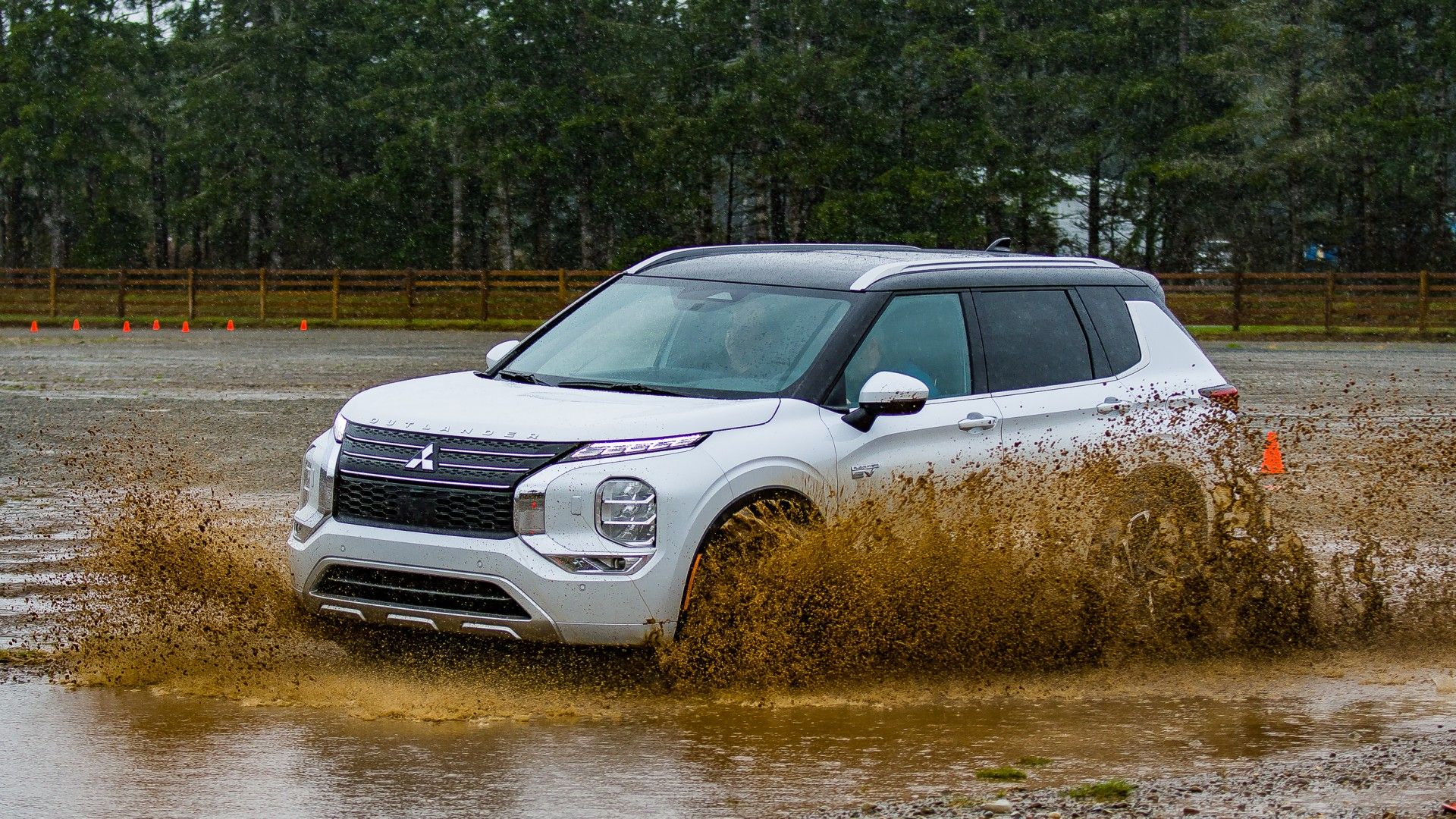
Styling is a very subjective matter, but I think we can all agree that the Outlander PHEV looks distinct. Dominating its front fascia is the Dynamic Shield grille, which is then flanked by split LED headlights that are subdivided into three sections–the daytime running lights, the main headlights, and the lower foglights (on SE and above).
The side profile has a strong character line running across its length, while the blacked-out A-pillars help create a floating roof effect. A black contrasting roof is available on higher variants, and so are nicer two-tone 20-inch wheels versus the 18-inch silver wheels on the base ES. Finally, an SEL Black Edition adds, as suggested by the trim designation, a lot of black trimmings that replace the car’s chrome trimmings.
Modern Interior With A Luxurious Potential

The interior of the Mitsubishi Outlander PHEV is undeniably modern and well-trimmed, with soft-touch materials and plenty of matte silver textures dotted around the cabin. It’s also a modern interior, as it’s fitted as standard with a 12.3-inch fully-digital gauge cluster, an eight-inch infotainment with Apple CarPlay and Android Auto, as well as heated front seats. Stepping up the trim ladder adds synthetic or genuine leather upholstery, power-adjustable front seats, a panoramic sunroof, and a hands-free powered tailgate. Oh, and did we mention that it’s the only seven-seater PHEV in its segment? Though the third-row seats are very tiny, to begin with.
Splurge for the Premium package when opting for the SEL trim, and you’ve got an Outlander PHEV that’s undeniably luxurious. For $49,095, which is obviously not cheap, your Outlander PHEV’s interior will be upholstered in fine black and saddle brown semi-aniline leather, along with quilted inserts and even massaging front seats. You also get a 9-speaker Bose sound system and a 10.8-inch windshield-projected head-up display.

Related
Mitsubishi Plans to Introduce New Vehicles and Open More Dealers by 2030
The ambitious plan will double Mitsubishi’s current lineup, increase dealerships across new North American markets, and update its brand image.
The Rocky Future Of Mitsubishi

Perhaps a part of the Outlander PHEV’s appeal is what the brand’s image in the United States is. With 109,843 vehicles sold last year, Mitsubishi grew by 25 percent from the prior year, it’s far from its sales peak of around 345,000 examples in the early 2000s. Today, 47 percent of sales are from the Outlander, which means that it’s the only appealing vehicle today in Mitsubishi’s North American lineup.
Building A Momentum

To be fair, the Outlander is selling okay, if not outstanding, relative to other compact crossover SUVs. It’s an appealing crossover SUV that comes from a brand with questionable appeal. But that’s set to change in the coming years with Mitsubishi’s “Momentum 2030” mid-term plan.
Under this plan, Mitsubishi Motors North America is set to introduce more electrified and rejuvenated vehicles into its lineup. Apart from the Outlander, everything else is old, antiquated, and far from the cutting edge of tech. More dealers will also be introduced to back up its rejuvenated lineup in the coming years, but this is considering if all things go according to plan despite these massive hurdles we’re about to mention.
A Rocky Love Triangle

Unfortunately, Mitsubishi is somewhat entangled in the Renault-Nissan-Mitsubishi alliance. This alliance’s solidity has been put into question ever since Nissan in late 2025 entered the negotiation table with Honda for a possible merger. Unless you’ve been living under a rock, you probably know by now that the deal is off, and with Renault and Mitsubishi being left out of any of these negotiations, what’s Mitsubishi’s role in all of these things?
Unfortunately, there seem to be more questions than answers regarding Mitsubishi’s position in all of these. Mitsubishi’s Momentum 2030 plan was developed when the Renault-Nissan-Mitsubishi alliance was in relatively good shape. Part of the expansion and investment plan is using resources within the alliance, but as we know today, the relationship between these three brands isn’t exactly at its most fruitful moment.